Chapter 05 Like the Venus Star
In the stars of the sky, Venus has no equal. Venus is considered the companion of the moon. The poets of the world are not tired of describing its radiance and splendor. Yet, in the constellation, the world cannot see this brilliant star, which is like a crest, for more than an hour or two either in the evening or very early in the morning. Similarly, brother Mahadev ji, after illuminating our sky with his radiance in the dawn of modern India’s independence, enchanting the country and the world, suddenly set like the Venus star. The late Mahadev Desai, born on this earth to serve, was Gandhi ji’s minister. Among friends, in jest, he used to feel proud of calling himself Gandhi ji’s ‘porter’ and sometimes introducing himself as his ‘Pir-Bawarchi-Bhishti-Khar’ (guide, cook, water-carrier, donkey).
For Gandhi ji, he was more than a son. When he reached Gandhi ji in 1917, Gandhi ji immediately recognized him and entrusted him with the position of his successor. In 1919, during the days of the Jallianwala Bagh massacre, Gandhi ji was arrested at Palwal station while going to Punjab. Gandhi ji had then called Mahadev bhai his heir. By 1929, Mahadev bhai had become the darling of the entire country, from Setubandha Rameshwaram to the Himalayas, in all four corners of the country.
Meanwhile, the details of the havoc wreaked by the military rule in Punjab started coming in daily. Most of Punjab’s leaders were arrested, given life sentences under martial law, and sent to Kala Pani (Andaman). The editor of Lahore’s leading national English daily ‘The Tribune’, Shri Kalinath Rai, was sentenced to 10 years in prison.
Crowds of victims kept pouring in at Gandhi ji’s Mani Bhavan in Gamdevi to present stories of oppression and atrocities before Gandhi ji. Mahadev would prepare brief notes of their statements and present them before Gandhi ji and also arrange face-to-face meetings for the visitors. Gandhi ji used to write articles on all these subjects in Bombay’s* leading national English daily ‘Bombay Chronicle’. There was always a space crunch in the Chronicle.
Within a few days, the government sentenced the fearless English editor of ‘Chronicle’, Horniman, to exile and sent him to England. In those days, there were three new leaders in Bombay: Shankarlal Banker, Umar Sobani, and Jamnadas Dwarkadas. The last among these was a follower of Mrs. Besant. These leaders also published an English weekly named ‘Young India’. But Horniman of the ‘Chronicle’ used to write mainly for it. After his exile, these people started facing a shortage of writers for the weekly. All three leaders were ardent admirers of Gandhi ji and were also Bombay’s unparalleled leaders in his Satyagraha movement. They requested Gandhi ji to become the editor of ‘Young India’. Gandhi ji sorely needed this. He immediately accepted the request.
Gandhi ji’s work increased so much that even a weekly paper started falling short. Gandhi ji decided to publish ‘Young India’ twice a week.
Apart from daily correspondence and meetings, public gatherings, etc., the articles, comments, summaries of Punjab affairs, and Gandhi ji’s writings to be printed in the ‘Young India’ weekly, we used to prepare all this material in three days.
Following ‘Young India’, ‘Navjivan’ also came to Gandhi ji, and both weeklies started publishing from Ahmedabad. For six months, I also reached Sabarmati Ashram * Currently called ‘Mumbai’.
to stay. Initially, the accounts of subscribers and the arrangement of mailing the weeklies were my responsibility. But within a few days, the entire management of both weeklies, including editing, and the printing press came under my charge. All of Gandhi ji and Mahadev’s time started being spent touring the country. Wherever they were, amidst a heavy crowd of work and programs, they would find time to write and send articles.
Radical and moderate patriots from all provinces, revolutionaries, stalwarts from India and abroad, correspondents, etc., used to write letters to Gandhi ji, and Gandhi ji used to discuss them in the columns of ‘Young India’. Mahadev used to send weekly accounts of Gandhi ji’s travels and his daily activities.
Besides, Mahadev also used to write articles from time to time taking to task the leading newspapers of India and abroad, who used to watch Gandhi ji’s daily activities with keen interest and constantly comment on them. Incomparable columns, full vigilance, Gandhi ji’s insistence on following the traditions of the highest British newspapers, and Gandhi ji’s training to debate with even the staunchest opponents with the humility and discretion born of complete truthfulness—all these qualities had made M.D. personally the darling of the entire newspaper world in India and abroad and among Anglo-Indian newspapers, despite sharp differences and opposing propaganda.
Before coming to Gandhi ji, during his student days, Mahadev had worked in the government’s translation department. Narhari Bhai was his bosom friend. Both studied law together. Both had also started legal practice together in Ahmedabad. In this profession, one usually has to turn black into white and white into black. It has no relation with literature and culture. But these two had started delving into the literature of Tagore, Sharatchandra, etc., from that very time. Translations like ‘Chitrangada’, the play ‘Vidai Ka Abhishap’ (The Curse of Farewell) composed by Tagore based on the story of Kacha-Devayani, ‘Stories of Sharad Babu’, etc., are gifts of their literary activities of that time.
In India, his handwriting had no equal. Letters addressed to the Viceroy from Gandhi ji always went in Mahadev’s handwriting. Seeing those letters, the Viceroys sitting in Delhi and Shimla used to heave long sighs. Even if in those days the sun never set on the British Empire, where would even the ‘small’ emperor of that empire find a calligrapher (a writer with beautiful handwriting) like Gandhi ji’s secretary? Big civilians and governors used to say that even after searching the entire British services, one could not find anyone with handwriting like Mahadev’s. Pure and beautiful writing that enchanted the reader.
Articles, comments, letters written by Mahadev’s hand, Gandhi ji’s speeches, prayer discourses, notes written on meetings, conversations—everything was written in thick practice books of quarter foolscap size, in longhand, with jet-like speed. He did not know shorthand.
Big Indian and foreign statesmen, politicians, representatives of leading newspapers from India and abroad, directors of international organizations, clergymen, authors, etc., used to come to meet Gandhi ji. These people themselves or their companions used to write down the conversation with Gandhi ji in shorthand. Mahadev, sitting in a corner, kept writing the entire discussion in his longhand. When the people who came for the meeting went to their place, typed the entire conversation, and reached Gandhi ji to get it ‘OK’d’, even if there were some mistakes or shortcomings in theirs, God forbid if there was even a comma’s mistake in Mahadev’s diary or notebook.
Gandhi ji would say: Should have just matched it a little with Mahadev’s ’note’. And people would be left biting their fingers.
Stalwart writers like Louis Fischer and Gunther hesitated to take their notes to Gandhi ji without correcting them after comparing them with Mahadev’s notes.
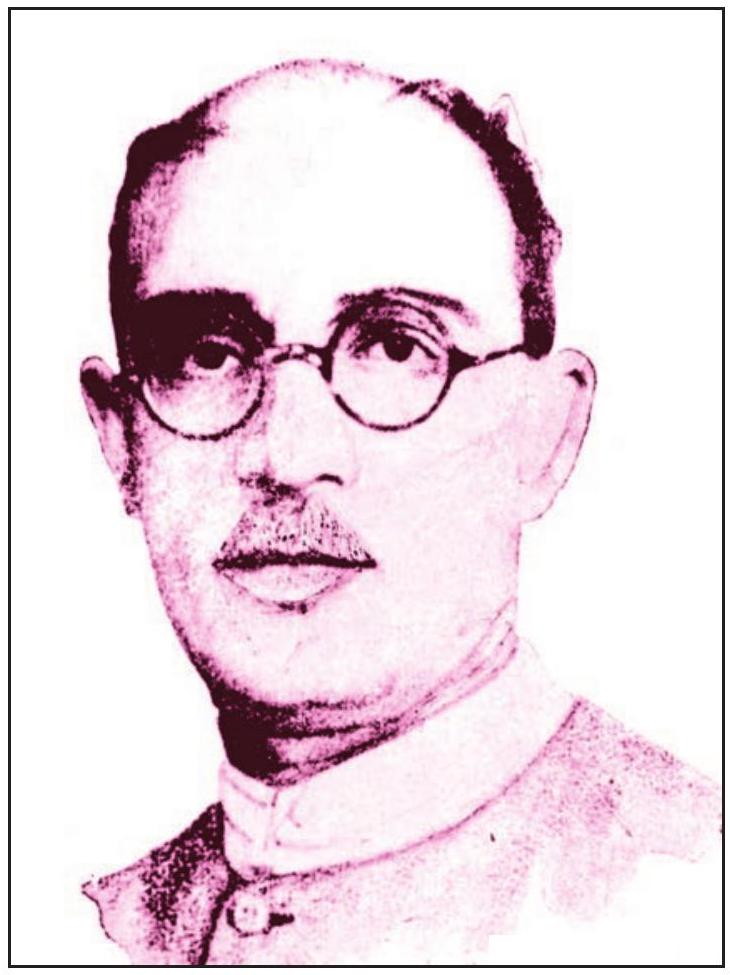
Mahadev Desai Just like literary books, Mahadev also kept reading books containing updated information related to current political trends and events. The latest information on the freshest political activities and discussions in India and abroad related to Hindustan could be obtained from him. In meetings, committee sittings, or sitting on the upper berth in moving train compartments, he kept reading the freshest newspapers, monthlies, and books kept stuffed in his big bags, or kept writing articles for ‘Young India’ and ‘Navjivan’. Amidst continuous travels, huge crowds of people gathered for darshan at every station, meetings, interviews, sittings, discussions, and conversations, no one could ever tell when he himself ate, bathed, slept, or attended to his needs. He would finish four hours of work in one hour. There was probably hardly ever any difference between night and day in his work. He also spun yarn very beautifully. Despite all his busyness, he never missed spinning.
The thousands of miles long plains of Bihar and Uttar Pradesh are made of the supremely beneficial, gold-worth ‘silt’ of the Ganga, Yamuna, and other rivers. You may walk a hundred kos, you will not find even a stone hard enough to crack a betel nut on the way. Similarly, anyone coming in contact with Mahadev never felt even rough soil or gravel, let alone a bump or a jolt. His pure genius bathed the person coming in contact with him in the radiance of the moon and Venus, drenching him in milk. The intoxication of this enchantment of his would not leave the mind of the one immersed in it for many days.
Mahadev’s entire life and all his work had become so intertwined and one with Gandhi ji that he could not even be imagined alone, separate from Gandhi ji. Amidst the continuous busyness of work, those countless practice books of his daily diary, written by finding time in a way no one could imagine, still exist today.
Mahadev was blessed with the divine gift of first-class polite, cultured language and charming writing style. Although after reaching Gandhi ji, amidst fierce battles, movements, and crowded contexts of newspaper discussions, he never got time solely for literary activities, still, he translated Gandhi ji’s autobiography ‘The Story of My Experiments with Truth’ into English, which kept getting published every week in ‘Young India’, just like the original Gujarati published in ‘Navjivan’. Later, countless editions of it were published and sold in countries all over the world.
In 1934-35, after Gandhi ji stayed in the women’s ashram in Wardha and in Maganwadi, he suddenly walked from Maganwadi and sat under a tree on the border of Sevagram. After that, one or two huts were built there and then gradually a house was built and completed; till then, Mahadev bhai stayed in Maganwadi with Durga Behn and Chh. Narayan. From there, he used to walk daily in the unbearable heat of Wardha to reach Sevagram in the morning. He would work there all day and return on foot in the evening. Going and coming, he walked a full 11 miles. This daily routine continued for a long time. Overall, the adverse effect this had could be considered one of the causes of his untimely death.
The wound of this death remained in Gandhi ji’s heart as long as he lived. He kept repeating this line of Bhartrihari’s hymn:
‘ए रे जखम जोगे नहि जशे’ - This wound will never be filled by yoga.
In later years, if he had to say something to Pyarelal ji, and Gandhi ji called him, even then ‘Mahadev’ would inadvertently come out of his mouth.
Translator: Shri Kashinath Trivedi
Questions-Exercises
#Oral
Answer the following questions in one or two lines-
1. How did Mahadev bhai introduce himself?
2. Why did ‘Young India’ weekly start facing a shortage of articles?
3. What decision did Gandhi ji take regarding publishing ‘Young India’?
4. Where did Mahadev bhai work before meeting Gandhi ji?
5. What was filled in Mahadev bhai’s bags?
6. Which famous book of Gandhi ji did Mahadev bhai translate?
7. Which two weeklies were published from Ahmedabad?
8. For how long did Mahadev bhai work during the day?
9. Which sentence proves Gandhi ji’s closeness to Mahadev bhai?
Written
(a) Write answers to the following questions in (25-30) words-
1. When did Gandhi ji call Mahadev his heir?
2. What did Mahadev bhai do for those who came to meet Gandhi ji?
3. What is Mahadev bhai’s literary contribution?
4. What was the cause of Mahadev bhai’s untimely death?
5. What did Gandhi ji say about the notes written by Mahadev bhai?
(b) Write answers to the following questions in (50-60 words)-
1. What havoc did the military rule wreak in Punjab?
2. Which qualities of Mahadev ji made him everyone’s darling?
3. What were the special features of Mahadev ji’s handwriting?
(c) Explain the meaning of the following-
1. ‘He felt proud introducing himself as his ‘Pir-Bawarchi-Bhishti-Khar’.
2. In this profession, one usually had to turn black into white and white into black.
3. After enchanting the country and the world, he suddenly set like the Venus star.
4. Seeing those letters, the Viceroys sitting in Delhi and Shimla kept heaving long sighs.
Language Study
1. Form words by adding the suffix ‘इक’ (ik)-
सप्ताह - साप्ताहिक अर्थ $ \qquad $……..
साहित्य - $ \qquad $…….. धर्म$ \qquad $……..
व्यक्ति - $ \qquad $…….. मास$ \qquad $……..
राजनीति - $ \qquad $…….. वर्ष$ \qquad $……..
2. Form words by using the following prefixes appropriately-
अ, नि, अन, दुर, वि, कु, पर, सु, अधि
आर्य - $ \qquad $…….. आगत $ \qquad $……..
डर - $ \qquad $…….. आकर्षण $ \qquad $……..
क्रय - $ \qquad $…….. मार्ग $ \qquad $……..
उपस्थित - $ \qquad $…….. लोक $ \qquad $……..
नायक - $ \qquad $…….. भाग्य $ \qquad $……..
3. Use the following idioms in your own sentences-
आड़े हाथों लेना $ \qquad $ अस्त हो जाना
दाँतों तले अंगुली दबाना $ \qquad $ मंत्र-मुग्ध करना
लोहे के चने चबाना
4. Write synonyms for the following words-
वारिस -$ \qquad $…….. जिगरी - $ \qquad $…….. कहर -$ \qquad $………
मुकाम -$ \qquad $…….. रूबरू -$ \qquad $…….. फ़र्क - $ \qquad $……..
गिरफ़्तार -$ \qquad $……..
5. Change the sentences as per the example-
Example: Gandhi ji had called Mahadev bhai his heir. Gandhi ji used to call Mahadev bhai his heir.
1. Mahadev bhai used to introduce himself as ‘Pir-Bawarchi-Bhishti-Khar’.
2. Crowds of victims kept pouring in at Mani Bhavan in Gamdevi.
3. Both weeklies used to be published from Ahmedabad.
4. Newspapers from India and abroad used to comment on Gandhi ji’s activities.
5. Gandhi ji’s letters always used to go in Mahadev’s handwriting.
Competency Expansion
1. Get Gandhi ji’s autobiography ‘The Story of My Experiments with Truth’ from the library and read it.
2. What incident happened at Jallianwala Bagh? Gather information.
3. Gather pictorial information about Bapu’s ashram in Ahmedabad.
4. A very bright planet is visible in the east 2-3 hours before sunrise or in the west 2-3 hours after sunset; that is the planet Venus. Its changing phases can be seen with a small telescope, like the phases of the moon.
5. In a deserted place where there are no lights, on a dark night when the moon is also not visible in the sky, one can see one’s own shadow moving by the light of the planet Venus (which we also call the Venus star). If you ever get a chance, experience it yourself.
Project Work
1. There are nine planets in the solar system. Venus is the second planet from the sun in order of distance, and Earth is the third. Write the order of other planets with pictures in your project notebook.
2. Organize a discussion in class on the topic ‘Gandhi ji’s Contribution to the Freedom Movement’.
3. Show the following places on the map of India:
Ahmedabad, Jallianwala Bagh (Amritsar), Kala Pani (Andaman), Delhi, Shimla, Bihar, Uttar Pradesh
Glossary and Notes
| आभा-प्रभा | - radiance, splendor, brilliance |
|---|---|
| नक्षत्र-मंडल | - constellation, star group |
| हम्माल | - porter, coolie |
| पीर | - guide, saint, sage |
| बावर्ची | - cook |
| भिश्ती | - water-carrier (one who carries water in a goatskin) |
| खर | - donkey, grass |
| आसेतुहिमाचल | - from Setubandha Rameshwaram to the Himalayas (the length and breadth of India) |
| दुलारे | - beloved, darling |
| ब्योरा | - details, account |
| कालापानी | - a place for keeping prisoners sentenced to life imprisonment, present-day Andaman and Nicobar Islands |
| रूबरू | - face-to-face |
| धुरंधर | - stalwart, one endowed with excellent qualities |
| टीका-टिप्पणी | - commentary, criticism |
| चौकसाई | - vigilance, keeping a watch |
| कट्टर | - staunch, rigid, one who is very insistent on his opinion or belief |
| लाड़ला | - beloved, darling |
| जिगरी दोस्त | - bosom friend, intimate friend |
| पेशा | - profession |
| स्याह | - black |
| सल्तनत | - empire, rule |
| व्याख्यान | - lecture, speech, explaining or commenting on a subject |
| फुलस्केप | - a size of paper (foolscap) |
| चौथाई | - one-fourth |
| अग्रगण्य | - leading, foremost |
| विवरण | - description, account |
| अद्यतन | - updated, pertaining to the present |
| गाद | - silt, sediment, thick substance |
| सराबोर | - drenched, immersed |
| अनवरत | - continuous, uninterrupted |
| सानी | - equal, match, another of the same kind |
| अनगिनत | - countless, innumerable |
| सिलसिला | - series, sequence |
| अनायास | - effortlessly, easily, without any effort |
| ‘पीर-बावर्ची भिश्ती-खर’ | - guide, cook, water-carrier, donkey (indicating a servant ready to do all kinds of work successfully) |
| श्रीमती बेसेंट (एनीबेसेंट ) | - Leader of the freedom movement. She founded the Home Rule League and the Theosophical Society. |








 BETA
BETA


