Chapter 01 The Right to Sorrow
The clothes of human beings divide them into different categories. Often, it is the attire that determines a person’s rights and status in society. It opens many closed doors for us, but sometimes a situation arises where we wish to stoop down a little and understand the feelings of the lower classes of society. At that time, this very attire becomes a bondage and a hindrance. Just as gusts of wind do not let a cut kite fall suddenly to the ground, in the same way, in specific circumstances, our attire prevents us from being able to stoop.
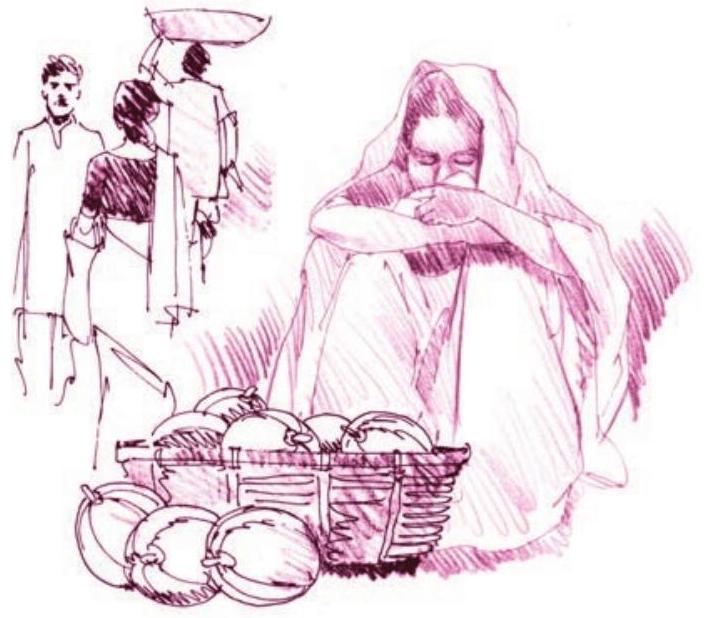
In the market, on the footpath Some melons seemed to be placed for sale in a basket and some on the ground. Near the melons, a middle-aged woman was sitting and crying. The melons were for sale, but how could anyone step forward to buy them? The woman selling the melons, hiding her face with her clothes, had her head on her knees and was sobbing and crying.
People sitting on the benches of neighboring shops or standing in the market were talking about that woman with disgust. Seeing that woman cry, a pang arose in my heart, but what was the way to know the reason for her crying? My attire itself became an obstacle, preventing me from sitting near her on the footpath.
One man said, spitting to the side with disgust, “What times are these! Not even a full day has passed since the young boy died, and this shameless woman has set up shop and is sitting here.”
Another gentleman, scratching his beard, was saying, “Oh, Allah gives blessings according to one’s intentions.”
A man standing on the opposite footpath, scratching his ear with a matchstick, said, “Oh, what do these people care? These scoundrels would give their lives for a piece of bread. For them, son-daughter, husband-wife, religion-faith are all just a piece of bread.”
Lala ji sitting at the grocery store said, “Oh brother, even if life and death have no meaning for them, they should at least consider other people’s religion and faith! When a young son dies, there is a thirteen-day period of impurity, and she has come here to sit on the road in the market to sell melons. Thousands of people come and go. Who knows there is impurity in her house? If someone eats her melons, how will their faith and religion remain? What darkness!”
Upon inquiring from the neighboring shops, it was found - she had a twenty-three-year-old young son. At home, there are his wife and grandchildren. The boy used to support the family by growing vegetables on about one and a half bighas of land near the city. After bringing the basket of melons to the market, sometimes the boy himself would sit by the goods, sometimes the mother would.
The day before yesterday, early in the morning, the boy was picking ripe melons from the vines. While resting in the coolness of the wet ridge, his foot fell on a snake. The snake bit the boy.
The boy’s old mother, frantic, brought an exorcist. There was chanting and blowing. Worship of Nagdev (the snake god) was performed. Donations and fees were needed for the worship. Whatever flour and
grain was in the house, went away in donations and fees. The mother, daughter-in-law, and children clung to ‘Bhagwana’ and cried, but Bhagwana, once he fell silent, did not speak again. His entire body had turned black from the snake’s venom.
A living person can remain naked too, but how can a dead person be sent off naked? For that, new cloth will have to be brought from the cloth merchant’s shop, even if the mother’s meager jewelry has to be sold for it.
Bhagwana departed for the other world. Whatever little flour and husk was in the house, was spent in sending him off. So what if the father is no more, the children, as soon as they wake up in the morning, start writhing with hunger. The grandmother gave them melons to eat, but what could she give to the daughter-in-law? The daughter-in-law’s body was burning with fever like a griddle. Now, without her son, who would lend the old woman even a few coins.
The old woman, crying and wiping her eyes, collected the melons gathered by Bhagwana into the basket and headed towards the market - and what other option was there?
The old woman had gathered the courage to come to sell melons, but with a shawl wrapped around her head, her head resting on her knees, she was sobbing and crying.
The one whose son passed away yesterday, today she has come to sell goods in the market, alas, stone-hearted!
To gauge the sorrow of that bereaved mother, I started thinking about the mother grieving her son’s death in my neighborhood last year. That respectable lady could not get up from her bed for two and a half months after her son’s death. She would faint from the grief of losing her son every fifteen minutes, and when not fainting, tears would not stop flowing from her eyes. Two doctors were constantly sitting by her bedside. Ice was constantly kept on her head. The hearts of people all over the city were moved by that son’s grief.
When the mind does not find a way out, restlessness makes the steps faster. In that same state, with my nose in the air, bumping into passersby, I was walking along. I was thinking - $ \qquad $ To mourn, to grieve, one also needs convenience and… there is also a right to be sorrowful.
Questions-Exercises
Oral
Answer the following questions in one or two lines-
1. What do we learn by looking at a person’s attire?
2. Why was no one buying melons from the woman selling melons?
3. How did the author feel upon seeing that woman?
4. What was the cause of that woman’s son’s death?
5. Why does no one lend to the old woman?
Written
(a) Write answers to the following questions (in 25-30 words)-
1. What is the importance of attire in a person’s life?
2. When does attire become a bondage and a hindrance for us?
3. Why couldn’t the author find out the reason for that woman’s crying?
4. How did Bhagwana support his family?
5. Why did the old woman set out to sell melons the very next day after the boy’s death?
6. Seeing the old woman’s sorrow, why did the author remember the respectable lady from his neighborhood?
(b) Write answers to the following questions (in 50-60 words)-
1. What were the people in the market saying about the woman selling melons? Write in your own words.
2. What did the author learn upon inquiring from the neighboring shops?
3. What all remedies did the old mother try to save the boy?
4. How did the author gauge the old woman’s sorrow?
5. To what extent is the title of this lesson ‘The Right to Sorrow’ meaningful? Explain.
(c) Explain the meaning of the following-
1. Just as gusts of wind do not let a cut kite fall suddenly to the ground, in the same way, in specific circumstances, our attire prevents us from being able to stoop.
2. For these people, son-daughter, husband-wife, religion-faith are all just a piece of bread.
3. To mourn, to grieve, one also needs convenience and… there is also a right to be sorrowful.
Language Study
1. Read and understand the following word groups-
(a) कङ्घा, पतङ-ग, चक्चल, ठण्डा, सम्बन्ध।
(b) कंघा, पतंग, चंचल, ठंडा, संबंध।
(c) अक्षुण्ण, सम्मिलित, दुअन्नी, चवन्नी, अन्न।
(d) संशय, संसद, संरचना, संवाद, संहार।
(e) अँधेरा, बाँट, मुँह, ईंट, महिलाएँ, में, मैं।
Note that ड़, ज्, ण्, न् and म् these five are called panchamakshar (nasal consonants). You have seen the ways of writing them above - in this form or in the form of anusvara. They can be written in either way and both are correct. However, when a panchamakshar comes twice, anusvara will not be used; for example- अम्मा, अन्न etc. Similarly, if after them come the antastha य, र, ल, व and ushma श, ष, स, ह etc., then anusvara will be used, but its pronunciation can be like any one of the pancham letters; for example- in संशय, संरचना ‘न्’, in संवाद ‘म्’ and in संहार ‘ड्’.
( ं ) This is the sign for anusvara and ( ँ ) this is the sign for anunasika. They are also called bindu and chandra-bindu respectively. There is a difference in their usage and pronunciation. Anusvara is used with consonants, anunasika with vowels.
2. Write synonyms of the following words-
ईमान $\qquad $ ……..
बदन $\qquad $ ……..
अंदाज़ा $\qquad $ ……..
बेचैनी $\qquad $ ……..
गम $\qquad $ ……..
दर्ज़ा $\qquad $ ……..
ज़मीन $\qquad $ ……..
ज़माना $\qquad $ ……..
बरकत $\qquad $ ……..
3. Following the example, pick out and write the word-pairs found in the lesson- Example: बेटा-बेटी
4. Explain the following phrases according to the context of the lesson-
बंद दरवाज़े खोल देना, निर्वाह करना, भूख से बिलबिलाना, कोई चारा न होना, शोक से द्रवित हो जाना।
5. Use the following word-pairs and word-groups in your own sentences-
(a) छन्नी-ककना $\qquad $ अढ़ाई-मास $\qquad $ पास-पड़ोस
दुअन्नी-चवन्नी $\qquad $ मुँह-अँधेरे $\qquad $ झाड़ना-फूँकना
(b) फफक-फफककर $\qquad $ बिलख-बिलखकर
तड़प-तड़पकर $\qquad $ लिपट-लिपटकर
6. Read the following sentence structures carefully and make some more sentences like these:
(a) 1. As soon as the boys woke up in the morning, they started writhing with hunger.
2. For that, cloth will have to be brought from the cloth merchant’s shop.
3. Even if the mother’s meager jewelry has to be sold for it.
(b) 1. Oh, Allah gives blessings according to one’s intentions.
2. Bhagwana, once he fell silent, did not speak again.
Competency Expansion
1. ‘A person is identified by their attire.’ Hold a discussion on this topic in class.
2. If you have seen any distressed person like Bhagwana’s mother, write their story.
3. Find out which snakes are poisonous? Collect their pictures and put them up on the bulletin board.
Word Meanings and Notes
| पोशाक | - | Clothes, attire |
|---|---|---|
| अनुभूति | - | Feeling, sensation |
| अड़चन | - | Obstacle, hindrance, impediment |
| अधेड़ | _ | Middle-aged, past middle age |
| व्यथा | Pain, sorrow | |
| व्यवधान | _ | Obstacle, hindrance |
| बेहया | - | Shameless, brazen |
| नीयत | - | Intention, purpose |
| बरकत | - | Increase, benefit, good fortune |
| खसम | - | Husband |
| लुगाई | - | Wife |
| परचून की दुकान | - | Grocery store (selling flour, rice, pulses etc.) |
| सूतक | - | A period of ritual impurity after a birth or death in the family |
| during which family members observe certain restrictions | ||
| कछियारी | - | Growing vegetables in fields |
| निर्वाह | - | Livelihood, sustenance |
| मेड़ | - | A ridge of earth built around a field, boundary between two fields |
| तरावट | - | Dampness, moisture, coolness |
| ओझा | - | Exorcist, one who performs rituals to cure |
| छन्नी-ककना | - | Simple, inexpensive jewelry |
| सहूलियत | - | Convenience, facility |








 BETA
BETA


